

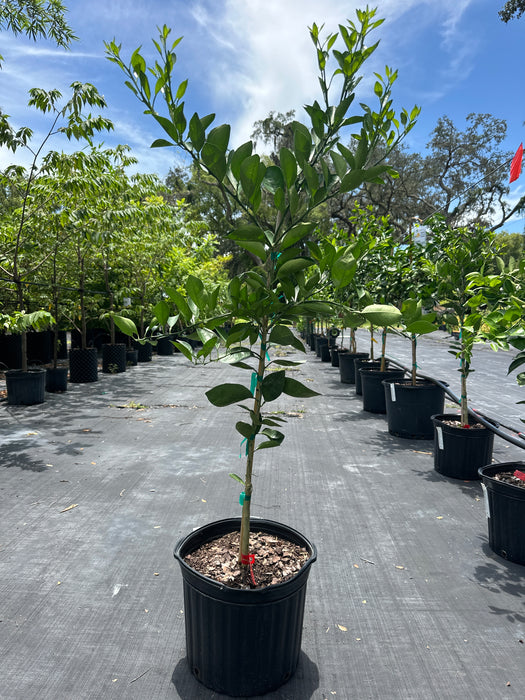

Orange - Red Navel Tree
Sale
Original price
$199.00
Original price
$199.00
-
Original price
$199.00
Original price
$199.00
Current price
$125.00
$125.00
-
$125.00
Current price
$125.00
The Red Navel Orange tree (Citrus sinensis), a vibrant mutation of the standard navel orange, is prized for its sweet, richly colored fruit and ornamental appeal. Known for its seedless, easy-to-peel fruit, this evergreen citrus tree is a favorite in warm climates and suitable for both garden and container growing. Below is a detailed guide to its characteristics and care requirements.Taste
Red Navel Oranges, often referred to as Cara Cara, have a sweet, slightly tangy flavor with a unique berry-like undertone. The flesh is a striking pinkish-red or deep orange, less acidic than other oranges, with a juicy, seedless interior. Their balanced sweetness and complex flavor make them ideal for fresh eating, juicing, or adding to salads and desserts, with a smooth, thin peel that enhances their appeal.Best Growing Environment
Red Navel Orange trees thrive in warm, subtropical climates with well-drained, slightly acidic to neutral soil (pH 5.5 to 7.0). They prefer moderate to high humidity and consistent temperatures between 70F and 85F (21°C to 29°C) for optimal growth. Good drainage is critical, as they are sensitive to waterlogged soils. A sheltered location that protects against strong winds helps maintain fruit quality and tree health, whether planted in coastal or inland regions.Common Names
Red Navel Orange trees are known by several names, reflecting their distinct characteristics:
Red Navel Orange trees typically grow to 8 to 12 feet tall with a spread of 8 to 10 feet when planted in the ground. Dwarf varieties, commonly used for container growing or small spaces, reach 4 to 8 feet in height. Pruning can maintain a compact shape, making them suitable for patios or home orchards.Growth Rate
These trees have a moderate growth rate, adding about 1 to 2 feet per year under ideal conditions. They establish within 2 to 3 years and often begin producing fruit within 2 to 4 years of planting, reaching full productivity after 5 to 7 years. Proper sunlight, water, and fertilization accelerate growth and enhance fruit yields.Sun Requirements
Red Navel Orange trees require full sun, needing at least 6 to 8 hours of direct sunlight daily to support vigorous growth and abundant fruiting. Insufficient sunlight can reduce flowering, fruit set, and overall tree vigor. Planting in a south-facing, open location ensures maximum sun exposure for optimal performance.Cold Hardiness
Red Navel Orange trees are hardy in USDA Zones 9 to 11, tolerating brief dips to 25F to 28F (-4°C to -2°C) when mature. Young trees are more frost-sensitive and require protection during cold snaps, such as frost blankets or burlap wraps. In Zone 8b, container growing or winter protection allows successful cultivation, with trees moved indoors during freezes.Water Requirements
Red Navel Orange trees have moderate water needs. Young trees require watering 2 to 3 times per week, providing 1 to 2 inches of water to establish roots. Mature trees need deep watering once or twice weekly during spring and summer, and every 10 to 14 days in fall and winter, depending on rainfall. Avoid overwatering to prevent root rot, ensuring soil dries slightly between waterings, especially in containers or heavy soils.Planting Guide
To plant a Red Navel Orange tree:
Fertilize Red Navel Orange trees to promote healthy growth and fruit production:
Red Navel Orange trees are best suited for USDA Hardiness Zones 9 to 11, thriving in regions like southern California, Florida, Arizona, and Texas. In Zone 8b, they can be grown with winter protection, such as frost covers or heaters. Container-grown trees are ideal for colder zones (8 or below), allowing them to be moved indoors to a bright, cool location during winter.
Red Navel Oranges, often referred to as Cara Cara, have a sweet, slightly tangy flavor with a unique berry-like undertone. The flesh is a striking pinkish-red or deep orange, less acidic than other oranges, with a juicy, seedless interior. Their balanced sweetness and complex flavor make them ideal for fresh eating, juicing, or adding to salads and desserts, with a smooth, thin peel that enhances their appeal.Best Growing Environment
Red Navel Orange trees thrive in warm, subtropical climates with well-drained, slightly acidic to neutral soil (pH 5.5 to 7.0). They prefer moderate to high humidity and consistent temperatures between 70F and 85F (21°C to 29°C) for optimal growth. Good drainage is critical, as they are sensitive to waterlogged soils. A sheltered location that protects against strong winds helps maintain fruit quality and tree health, whether planted in coastal or inland regions.Common Names
Red Navel Orange trees are known by several names, reflecting their distinct characteristics:
- Cara Cara Orange
- Red Flesh Navel
- Pink Navel Orange
- Washington Red Navel
Red Navel Orange trees typically grow to 8 to 12 feet tall with a spread of 8 to 10 feet when planted in the ground. Dwarf varieties, commonly used for container growing or small spaces, reach 4 to 8 feet in height. Pruning can maintain a compact shape, making them suitable for patios or home orchards.Growth Rate
These trees have a moderate growth rate, adding about 1 to 2 feet per year under ideal conditions. They establish within 2 to 3 years and often begin producing fruit within 2 to 4 years of planting, reaching full productivity after 5 to 7 years. Proper sunlight, water, and fertilization accelerate growth and enhance fruit yields.Sun Requirements
Red Navel Orange trees require full sun, needing at least 6 to 8 hours of direct sunlight daily to support vigorous growth and abundant fruiting. Insufficient sunlight can reduce flowering, fruit set, and overall tree vigor. Planting in a south-facing, open location ensures maximum sun exposure for optimal performance.Cold Hardiness
Red Navel Orange trees are hardy in USDA Zones 9 to 11, tolerating brief dips to 25F to 28F (-4°C to -2°C) when mature. Young trees are more frost-sensitive and require protection during cold snaps, such as frost blankets or burlap wraps. In Zone 8b, container growing or winter protection allows successful cultivation, with trees moved indoors during freezes.Water Requirements
Red Navel Orange trees have moderate water needs. Young trees require watering 2 to 3 times per week, providing 1 to 2 inches of water to establish roots. Mature trees need deep watering once or twice weekly during spring and summer, and every 10 to 14 days in fall and winter, depending on rainfall. Avoid overwatering to prevent root rot, ensuring soil dries slightly between waterings, especially in containers or heavy soils.Planting Guide
To plant a Red Navel Orange tree:
- Choose a sunny, well-drained site, at least 15 to 20 feet from structures or other trees.
- Dig a hole twice as wide and as deep as the root ball.
- Amend soil with compost or well-rotted manure to improve drainage and fertility.
- Place the tree in the hole, keeping the bud union (graft) 2 to 4 inches above the soil line.
- Backfill with soil, tamp gently, and water thoroughly.
- Apply 2 to 3 inches of organic mulch (e.g., wood chips or bark), keeping it 6 inches from the trunk to prevent rot.
- For containers, use a pot at least 15 gallons with drainage holes and a citrus-specific, well-draining potting mix.
Fertilize Red Navel Orange trees to promote healthy growth and fruit production:
- Early Spring (February/March): Apply a citrus-specific fertilizer (e.g., 6-6-6 or 8-8-8 NPK) as new growth begins. Use 1 to 2 cups for young trees or 3 to 4 cups for mature trees, spread around the drip line and watered in well.
- Early Summer (May/June): Apply a second dose of the same fertilizer to support fruit development, using half the spring amount to avoid excess nitrogen.
- Late Summer (August): Apply a light dose of a potassium-rich fertilizer (e.g., 5-5-10) to enhance fruit quality and prepare the tree for dormancy.
- Container Trees: Fertilize every 6 to 8 weeks during the growing season with a liquid citrus fertilizer (e.g., 5-1-3), diluted per package instructions. Avoid fertilizing after September to prevent frost-sensitive growth.
Red Navel Orange trees are best suited for USDA Hardiness Zones 9 to 11, thriving in regions like southern California, Florida, Arizona, and Texas. In Zone 8b, they can be grown with winter protection, such as frost covers or heaters. Container-grown trees are ideal for colder zones (8 or below), allowing them to be moved indoors to a bright, cool location during winter.