

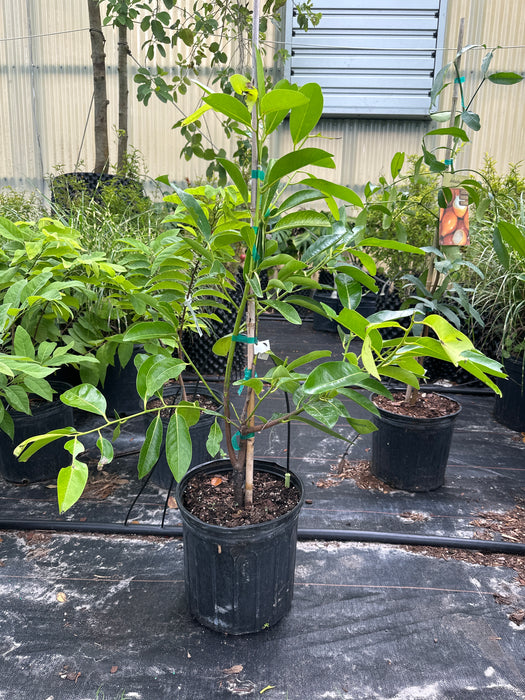
Black Sapote Matts Giant
Sold out
Original price
$89.00
-
Original price
$89.00
Original price
$89.00
$89.00
-
$89.00
Current price
$89.00
The Black Sapote Matt’s Giant Tree, scientifically known as Diospyros nigra or Diospyros digyna, is a tropical evergreen fruit tree celebrated for its unique fruit, often called the "chocolate pudding fruit" due to its creamy, dark pulp. Native to Central America, this cultivar is a standout for its large, flavorful fruit and adaptability to warm climates. Below is a detailed overview of its characteristics, care requirements, and planting guidelines, tailored specifically to the Matt’s Giant variety.Taste
The fruit of the Black Sapote Matt’s Giant is renowned for its rich, custard-like texture and mild, sweet flavor, often likened to chocolate pudding with subtle hints of caramel or dates. The pulp is dark brown to black, silky, and slightly gelatinous, contrasting with its green to dull green skin when ripe. While some describe it as a light chocolate taste, others note it’s less sweet than expected, with a unique, dessert-like quality that’s not overly sugary. It’s ideal for eating fresh, blending into smoothies, or using in desserts like ice cream, enhanced with honey or lemon for added depth.Best Growing Environment
The Black Sapote Matt’s Giant thrives in warm, humid tropical or subtropical climates, preferring well-draining soil rich in organic matter, such as sandy loam or soil amended with compost. It grows best in lowland tropical regions like southern Florida, Puerto Rico, or coastal Central America, where temperatures stay above 30°F. The tree tolerates a range of soil types, including sandy or limestone-based soils, but performs poorly in waterlogged conditions. A wind-protected location is crucial to prevent damage to its delicate trunk and large, glossy leaves. In cooler climates, it can be grown in large containers (20–30 gallons) for indoor overwintering, making it versatile for patio or greenhouse cultivation.Common Names
The Black Sapote Matt’s Giant is known by several names, reflecting its distinctive fruit and cultural significance:
The Matt’s Giant Black Sapote typically reaches 25–40 feet in height when grown in the ground in tropical climates, with a canopy spread of 20–30 feet. In containers or with regular pruning, it can be maintained at 7–15 feet, making it suitable for smaller spaces or patio growing. Its broad, rounded canopy and prominent black bark give it an attractive, ornamental appearance, though its size requires ample space in outdoor landscapes.Growth Rate
This cultivar has a slow to moderate growth rate, adding about 1–2 feet per year under optimal conditions. Seed-grown trees may take 5–6 years to bear fruit, while grafted Matt’s Giant trees can produce in 3–4 years. Growth accelerates after the tree matures, particularly with consistent care. Pruning during the first few years helps shape the tree and encourages fruit production, but over-fertilizing or poor drainage can slow growth. The tree’s evergreen nature ensures steady growth in warm climates year-round.Sun Requirements
The Black Sapote Matt’s Giant requires full sun, with 6–8 hours of direct sunlight daily, to maximize growth and fruit production. In hot climates, partial afternoon shade can prevent leaf burn, especially for young trees. When grown indoors or as a patio plant, place it near a west- or south-facing window or under grow lights to ensure adequate light. Insufficient sunlight results in reduced fruiting and leggy growth, so a bright, open location is essential for optimal health.Cold Hardiness
This tree is hardy in USDA Zones 9b–11, tolerating minimum temperatures of 28–30°F for mature trees. Young trees are more sensitive, suffering damage below 32°F. In Zone 9b, winter protection like frost cloths or indoor relocation for potted trees is necessary to prevent leaf drop or death. Mature trees can withstand brief cold snaps, but prolonged exposure below 28°F may cause significant damage or kill the tree.Water Requirements
The Black Sapote Matt’s Giant prefers consistently moist but well-draining soil, especially during establishment. Young trees should be watered every other day for the first week, then 1–2 times weekly for the first few months, ensuring the top 2–3 inches of soil remain moist. Mature trees (4+ years) require watering only during prolonged dry periods (e.g., 5+ days without rain), as overwatering can lead to root rot or decline. For potted trees, water when the top inch of soil is dry, ensuring excess water drains to avoid waterlogging. In humid tropical climates like Puerto Rico, natural rainfall often suffices except during dry seasons.Planting Guide
To plant a Black Sapote Matt’s Giant Tree:
Fertilize young Black Sapote Matt’s Giant trees every 6–8 weeks during the growing season (March–September) with a balanced, slow-release fertilizer, such as a 6-6-6-2 (N-P-K-Mg) or 8-3-9, starting with 1/4 lb (113 g) and increasing to 1 lb (454 g) by the end of the first year. For mature trees, apply 3–5 lbs (1.4–2.3 kg) of the same fertilizer 2–3 times per year, from spring to early fall (April–September). Additionally, use 2–3 foliar sprays of micronutrients (e.g., zinc, manganese, boron) annually from April to September to address deficiencies, especially in calcareous soils. Avoid fertilizing in late fall or winter (October–February) to prevent new growth vulnerable to cold. Organic options like compost or fish emulsion can supplement chemical fertilizers for young trees.
The fruit of the Black Sapote Matt’s Giant is renowned for its rich, custard-like texture and mild, sweet flavor, often likened to chocolate pudding with subtle hints of caramel or dates. The pulp is dark brown to black, silky, and slightly gelatinous, contrasting with its green to dull green skin when ripe. While some describe it as a light chocolate taste, others note it’s less sweet than expected, with a unique, dessert-like quality that’s not overly sugary. It’s ideal for eating fresh, blending into smoothies, or using in desserts like ice cream, enhanced with honey or lemon for added depth.Best Growing Environment
The Black Sapote Matt’s Giant thrives in warm, humid tropical or subtropical climates, preferring well-draining soil rich in organic matter, such as sandy loam or soil amended with compost. It grows best in lowland tropical regions like southern Florida, Puerto Rico, or coastal Central America, where temperatures stay above 30°F. The tree tolerates a range of soil types, including sandy or limestone-based soils, but performs poorly in waterlogged conditions. A wind-protected location is crucial to prevent damage to its delicate trunk and large, glossy leaves. In cooler climates, it can be grown in large containers (20–30 gallons) for indoor overwintering, making it versatile for patio or greenhouse cultivation.Common Names
The Black Sapote Matt’s Giant is known by several names, reflecting its distinctive fruit and cultural significance:
- Chocolate Pudding Fruit
- Black Persimmon
- Black Sapote
- Matt’s Giant Black Sapote
- Diospyros nigra or Diospyros digyna (botanical names)
The Matt’s Giant Black Sapote typically reaches 25–40 feet in height when grown in the ground in tropical climates, with a canopy spread of 20–30 feet. In containers or with regular pruning, it can be maintained at 7–15 feet, making it suitable for smaller spaces or patio growing. Its broad, rounded canopy and prominent black bark give it an attractive, ornamental appearance, though its size requires ample space in outdoor landscapes.Growth Rate
This cultivar has a slow to moderate growth rate, adding about 1–2 feet per year under optimal conditions. Seed-grown trees may take 5–6 years to bear fruit, while grafted Matt’s Giant trees can produce in 3–4 years. Growth accelerates after the tree matures, particularly with consistent care. Pruning during the first few years helps shape the tree and encourages fruit production, but over-fertilizing or poor drainage can slow growth. The tree’s evergreen nature ensures steady growth in warm climates year-round.Sun Requirements
The Black Sapote Matt’s Giant requires full sun, with 6–8 hours of direct sunlight daily, to maximize growth and fruit production. In hot climates, partial afternoon shade can prevent leaf burn, especially for young trees. When grown indoors or as a patio plant, place it near a west- or south-facing window or under grow lights to ensure adequate light. Insufficient sunlight results in reduced fruiting and leggy growth, so a bright, open location is essential for optimal health.Cold Hardiness
This tree is hardy in USDA Zones 9b–11, tolerating minimum temperatures of 28–30°F for mature trees. Young trees are more sensitive, suffering damage below 32°F. In Zone 9b, winter protection like frost cloths or indoor relocation for potted trees is necessary to prevent leaf drop or death. Mature trees can withstand brief cold snaps, but prolonged exposure below 28°F may cause significant damage or kill the tree.Water Requirements
The Black Sapote Matt’s Giant prefers consistently moist but well-draining soil, especially during establishment. Young trees should be watered every other day for the first week, then 1–2 times weekly for the first few months, ensuring the top 2–3 inches of soil remain moist. Mature trees (4+ years) require watering only during prolonged dry periods (e.g., 5+ days without rain), as overwatering can lead to root rot or decline. For potted trees, water when the top inch of soil is dry, ensuring excess water drains to avoid waterlogging. In humid tropical climates like Puerto Rico, natural rainfall often suffices except during dry seasons.Planting Guide
To plant a Black Sapote Matt’s Giant Tree:
- Location: Choose a sunny, wind-sheltered site at least 25–30 feet from buildings, trees, or power lines to accommodate its mature size. For containers, use a 20–30-gallon pot with drainage holes.
- Soil Preparation: Dig a hole 3–4 times the diameter and 3 times the depth of the root ball, mixing native soil with 25% compost or organic matter for fertility and drainage. In high water table areas, plant on a 3–4-foot-high mound.
- Planting: Remove the tree from its container, loosen roots, and place it in the hole at the same depth as it was grown. Backfill, tamp to remove air pockets, and water thoroughly.
- Mulching: Apply 3–4 inches of organic mulch (e.g., wood chips) in a 3–4-foot radius, keeping it 8 inches from the trunk to prevent rot.
- Spacing: Space trees 25–30 feet apart to allow canopy and root spread.
- Container Planting: Use a well-draining potting mix and repot every 2–3 years to prevent root-binding.
Fertilize young Black Sapote Matt’s Giant trees every 6–8 weeks during the growing season (March–September) with a balanced, slow-release fertilizer, such as a 6-6-6-2 (N-P-K-Mg) or 8-3-9, starting with 1/4 lb (113 g) and increasing to 1 lb (454 g) by the end of the first year. For mature trees, apply 3–5 lbs (1.4–2.3 kg) of the same fertilizer 2–3 times per year, from spring to early fall (April–September). Additionally, use 2–3 foliar sprays of micronutrients (e.g., zinc, manganese, boron) annually from April to September to address deficiencies, especially in calcareous soils. Avoid fertilizing in late fall or winter (October–February) to prevent new growth vulnerable to cold. Organic options like compost or fish emulsion can supplement chemical fertilizers for young trees.