

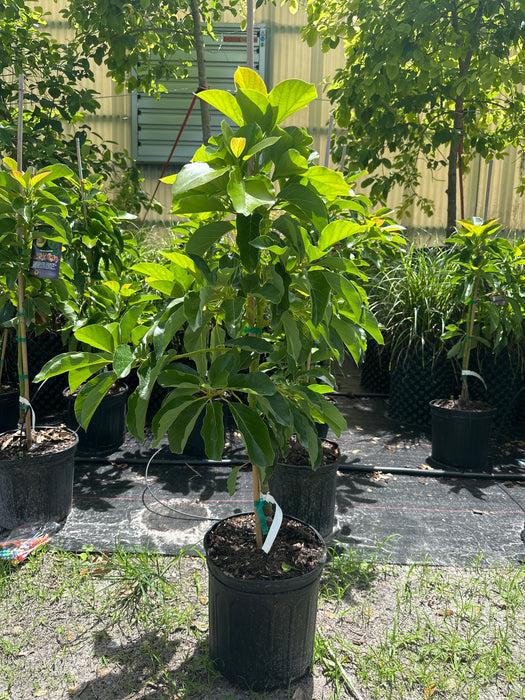


Avocado-Miguel Tree Type B
Original price
$59.00
-
Original price
$159.00
Original price
$119.00
$59.00
-
$159.00
Current price
$119.00
Miguel Avocado Tree Overview
-
Taste
- The Miguel Avocado (Persea americana 'Miguel'), formerly known as ‘Zutano,’ produces medium-sized, pear-shaped fruits with smooth, thin, green skin that remains green when ripe. The flesh is creamy, pale green to yellow, with a mild, slightly nutty flavor and moderate oil content, less rich than Hass but versatile for guacamole, salads, or spreads.
- Its taste is described as less intense but refreshing, with a smooth texture ideal for culinary uses, though some prefer it as a complementary ingredient rather than a standalone fruit.
- Fruits typically weigh 8–16 ounces and are harvested from late fall to early winter, offering a reliable yield for home growers.
-
Best Growing Environment
- Thrives in subtropical climates with warm, humid summers and mild winters, ideally in temperatures between 60–85F, such as coastal regions of California, southern Florida, or Hawaii.
- Prefers well-draining, fertile soils with a slightly acidic to neutral pH (5.5–7.0); sandy loam or loamy soils are ideal, while heavy clay or waterlogged soils should be avoided to prevent root rot.
- Benefits from a sheltered location with good air circulation but protection from strong winds, which can damage flowers or young fruit; microclimates near south-facing walls enhance cold tolerance in marginal zones.
-
Common Names
- Miguel Avocado, Zutano (former commercial name), Mexican Avocado (due to its heritage), or Green-Skinned Avocado in some markets.
- Occasionally referred to as a “winter avocado” in regions like California due to its harvest season.
-
Average Height
- Reaches 15–25 feet tall when planted in the ground with regular pruning to maintain size and shape; unpruned trees may grow to 30–40 feet in optimal conditions.
- In containers, trees can be kept at 5–8 feet with consistent pruning, making them suitable for patios or indoor overwintering in cooler climates.
-
Growth Rate
- Moderate growth rate, adding 1–2 feet per year under ideal conditions, with grafted trees like Miguel typically fruiting within 3–5 years compared to 5–10 years for seed-grown trees.
- Growth slows in cooler temperatures or poor soil conditions, but young trees establish quickly with proper care.
-
Sun Requirements
- Requires full sun with at least 6–8 hours of direct sunlight daily to support vigorous growth, flowering, and fruit production; insufficient light reduces yields and weakens the tree.
- Young trees may tolerate partial shade during establishment but perform best in full sun as they mature; container plants should be rotated to ensure even exposure.
-
Cold Hardiness
- Moderately cold-hardy for an avocado, tolerating brief dips to 26–28F once established, though young trees are more sensitive and require protection below 32F.
- In regions with occasional frost, use frost blankets or plant in sheltered locations; container-grown trees can be moved indoors when temperatures drop below 40F.
- Unsuitable for prolonged freezing conditions unless grown as a potted plant with winter protection.
-
Water Requirements
- Needs regular, deep watering during establishment (first 1–2 years), about 1–2 times weekly, ensuring the top 2 inches of soil dry out between waterings to prevent root rot.
- Mature trees are moderately drought-tolerant but benefit from weekly watering during dry spells, especially during flowering and fruit set (spring to early summer); reduce watering in winter.
- Use mulch (e.g., wood chips) around the base to retain moisture, keeping it 6 inches from the trunk to avoid fungal issues.
-
Planting Guide
- Plant in spring or early summer to allow establishment before cooler weather, selecting a sunny, well-draining site at least 10–15 feet from structures or other trees.
- Dig a hole 2–3 times wider and as deep as the root ball, amending with 20–30% compost if soil is poor; ensure the graft union remains 2–3 inches above soil level and water thoroughly after planting.
- For containers, use a 15–20 gallon pot with drainage holes, filled with a well-draining mix (e.g., cactus or citrus soil); repot every 2–3 years to refresh nutrients and accommodate root growth.
-
Stake young trees to protect from wind and space in-ground trees 15–20 feet apart to allow for canopy spread.

-
Fertilizing Times and Recommended Fertilizer
- First Year: Fertilize every 6–8 weeks from spring to fall (March, May, July, September) with a balanced, nitrogen-rich fertilizer like 6-2-2 or 8-3-9 (e.g., Dr. Earth Citrus & Fruit), starting with ¼ lb per application and increasing to ½ lb by year’s end.
- Mature Trees: Apply fertilizer 3 times annually—early spring (February), early summer (June), and early fall (August)—using 1–2 lbs of a citrus/avocado-specific blend like 10-5-10 or SUNSHINE C-Cibus (NPK 2-2-4) per inch of trunk diameter, spread under the canopy and watered in.
-
Supplement with micronutrients (zinc, iron, manganese) annually in spring if leaves show yellowing; avoid fertilizing in late fall or winter to prevent frost-sensitive new growth.
-
Pollination A or B
- Miguel Avocado is a Type B flower, with flowers opening as female in the morning of day 1 and as male in the afternoon of day 2, exhibiting synchronous dichogamy to promote cross-pollination.
- While self-fertile and capable of producing fruit alone, planting near a Type A variety (e.g., Hass, Mexicola) significantly increases fruit set and yield due to enhanced cross-pollination by bees.
-
Ensure pollinators like bees are active in the area, and avoid pesticide use during flowering (spring) to support pollination.
-
USDA Zone
- Thrives in USDA Zones 9a–11, with optimal growth in Zones 9b–10b (minimum temperatures 25–40F), including coastal California, southern Florida, and parts of Texas.
-
In Zone 9a or cooler (e.g., Zones 4–8), grow in containers and move indoors during winter, maintaining temperatures above 40F; use frost protection (e.g., frost cloth) for in-ground trees in marginal zones.
