

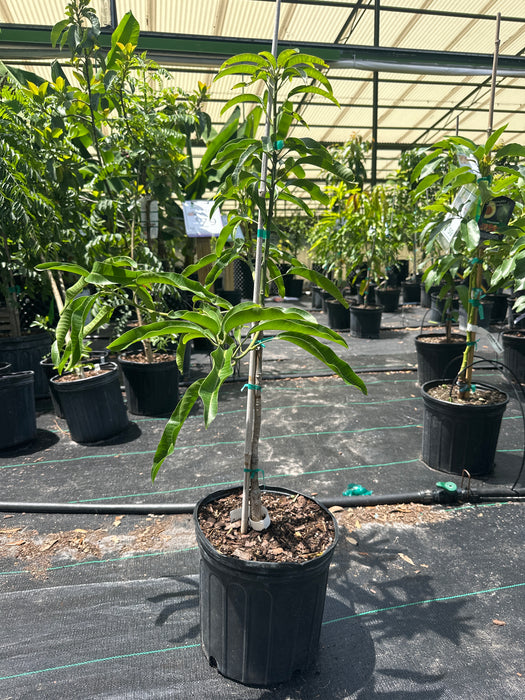

Mango-Okrung Tree
Original price
$59.00
-
Original price
$119.00
Original price
$119.00
$59.00
-
$119.00
Current price
$119.00
Okrung Mango Tree Overview
-
Taste
- The Okrung Mango (Mangifera indica 'Okrung') produces small fruits, typically weighing 0.5–0.75 lbs, with an exceptionally sweet, rich Indo-Chinese flavor often likened to sugarcane when fully ripe.
- Its light yellow flesh is juicy with minimal, non-objectionable fiber, offering a smooth texture; the fruit can also be enjoyed green for a tangy taste, a common practice in Thailand.
-
The flavor intensifies as the fruit ripens to a greenish-yellow or dull yellow with occasional red blush, making it ideal for fresh eating or culinary uses like mango leather, which crystallizes with sugar over time.

-
Best Growing Environment
- Thrives in tropical and subtropical climates with warm, humid conditions, ideally between 75–95F, and humidity above 50%, such as in southern Florida, southern California, or Hawaii.
- Prefers well-draining, sandy loam soil with a pH of 5.5–7.5, enriched with organic matter to support robust root growth; avoid heavy clay or waterlogged soils.
-
Benefits from a sunny, wind-protected location to prevent damage to flowers and fruit, with microclimates near buildings enhancing survivability in marginal zones.

-
Botanical Name
- Mangifera indica 'Okrung', a cultivar of the mango species within the Anacardiaceae family, native to South Asia but widely cultivated in tropical regions.
-
Common Names
- Okrung Mango, Okrung, Thai Okrung; sometimes confused with Okrung Tong, a related Thai variety with similar characteristics.
-
Average Height
- Grows to 10–15 feet tall with annual pruning, forming a moderately vigorous, upright canopy; unpruned trees may reach 20–25 feet in optimal conditions.
-
Not suitable for long-term container growth due to its vigor and root expansion needs, unlike dwarf mango varieties like ‘Ice Cream’ or ‘Cogshall’.
-
Growth Rate
- Moderate to fast growth rate, adding 1–2 feet per year under ideal conditions, with grafted trees fruiting within 2–4 years compared to 5–8 years for seed-grown trees.
-
Young trees may have sparse fruit production due to infrequent flowering, but mature trees yield fair to average crops.
-
Sun Requirements
- Requires full sun with at least 8–10 hours of direct sunlight daily to ensure healthy growth, flowering, and abundant fruit production.
-
Insufficient sunlight leads to reduced flowering and lower yields; young trees may need partial shade in extreme heat to prevent sunburn.
-
Cold Hardiness
- Sensitive to cold, with mature trees tolerating brief dips to 30F, but young trees require protection below 40F to prevent leaf, flower, or fruit damage.
-
Unsuitable for regions with prolonged frost; in cooler climates (e.g., Zone 9b), grow in containers and move indoors during winter or use frost blankets.
-
Water Requirements
- Needs regular watering during establishment (first 2–3 years), about 2–3 times weekly, keeping soil evenly moist but not soggy to avoid root rot.
-
Mature trees are moderately drought-tolerant but benefit from deep watering every 7–10 days during dry periods, reducing to biweekly in cooler months; consistent moisture enhances fruit quality.

-
Planting Guide
- Plant in spring after the last frost in a sunny, well-draining location, at least 15–20 feet from structures or other trees to accommodate mature size.
- Dig a hole 2–3 times wider and as deep as the root ball, mixing native soil with 30–40% compost; keep the graft union above ground and water thoroughly after planting.
-
Apply 2–3 inches of organic mulch (e.g., bark), keeping it 2 inches from the trunk; for containers, use a pot at least 20 inches wide with drainage holes, though Okrung’s vigor limits long-term pot suitability.
-
Fertilizing Times and Recommended Fertilizer
- First Year: Fertilize every 2–3 months (March, May, July, September) with a balanced, slow-release fertilizer like 6-6-6 or 8-3-9, including micronutrients (zinc, manganese), using ¼–½ lb per application to encourage root and foliage growth.
- Mature Trees: Apply fertilizer 2–3 times annually—early spring (February), early summer (June), and late summer (August)—using 1–2 lbs per inch of trunk diameter of a balanced 10-10-10 or SUNSHINE Mango Tango (NPK 2-2-4) to support fruiting and recovery.
-
Avoid fertilizing in late fall or winter to prevent vulnerable new growth; apply chelated iron (e.g., FeEDDHA) 2–3 times per year for high pH soils if leaves yellow.
-
USDA Zone
- Thrives in USDA Zones 9b–11, with optimal growth in Zones 10a–11 (minimum temperatures 25–40F), including southern Florida, southern Texas, and coastal California.
-
In Zone 9b, use containers for mobility during cold snaps or provide frost protection (e.g., frost cloth) to safeguard young trees.