


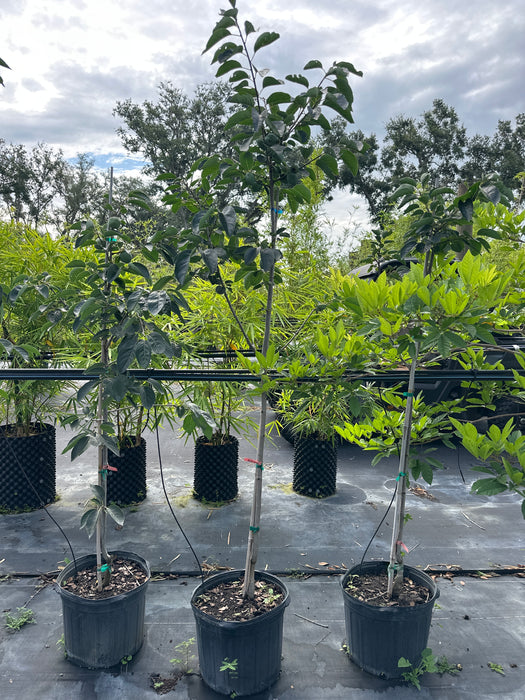


Persimmon-American
Sold out
Original price
$119.00
-
Original price
$119.00
Original price
$119.00
$119.00
-
$119.00
Current price
$119.00
Persimmon American Tree Overview
We have both Moris Burton and Prok varieties commonly called Deer Candy
-
Taste
-
The American Persimmon is known for its rich, sweet flavor when fully ripened, often described as a mix of honey and apricot with a soft, pudding-like texture.
-
Unripe fruit is highly astringent, causing a puckering sensation due to tannins, but ripened fruit (soft and dark) is prized for eating fresh, baking, or making preserves.
-
Its unique taste makes it a traditional favorite in North American cuisine, especially in desserts like persimmon pudding.
-
-
Best Growing Environment
-
The American Persimmon thrives in temperate climates with warm summers and cold winters, native to the eastern and central United States.
-
It prefers well-drained, loamy or sandy soils with a pH of 6.0 to 7.0, though it adapts to a wide range of soil types, including clay, if drainage is adequate.
-
A site with good air circulation and some natural moisture, such as near woodlands or streams, supports its growth and fruiting.
-
-
Botanical Name
-
The botanical name is Diospyros virginiana.
-
It belongs to the Ebenaceae family, alongside its Asian cousin Diospyros kaki and other ebony species.
-
-
Common Names
-
Commonly known as American Persimmon.
-
Also called Common Persimmon, Eastern Persimmon, or Possumwood due to its appeal to wildlife like opossums.
-
In some regions, it’s nicknamed “Date Plum” for its date-like sweetness when ripe.
-
-
Average Height
-
Typically grows to an average height of 30 to 60 feet at maturity in the wild, though cultivated trees are often kept at 15 to 30 feet with pruning.
-
Its canopy spreads 20 to 35 feet wide, forming an irregular, oval shape that provides moderate shade.
-
Smaller cultivars or rootstock can limit height to 10 to 20 feet for easier harvesting in gardens.
-
-
Growth Rate
-
Exhibits a slow to moderate growth rate, adding about 1 foot per year, though this can vary with soil quality and care.
-
Growth is slower in youth as it establishes a deep root system, then picks up slightly in maturity under good conditions.
-
It may take 7 to 10 years to bear fruit, reflecting its patient, long-term development.
-
-
Sun Requirements
-
Prefers full sun, requiring 6 to 8 hours of direct sunlight daily for optimal fruit production and tree vigor.
-
Tolerates partial shade (4-6 hours), but reduced light can delay fruiting and diminish yield.
-
Plant in an open area to maximize sun exposure and encourage robust growth.
-
-
Cold Hardiness
-
Hardy in USDA zones 4 to 9, withstanding temperatures as low as -25°F to -30°F (-32°C to -34°C) when dormant, making it one of the toughest fruit trees.
- Its chill requirement (200-400 hours below 45°F/7°C) suits colder climates better than many fruit trees.
-
-
Water Requirements
-
Needs moderate watering, about 1 inch per week during the growing season, thriving in naturally moist but well-drained soils.
-
Drought-tolerant once established, it can survive dry spells but produces better fruit with consistent moisture, especially in summer.
-
Avoid waterlogged conditions; water young trees weekly until rooted, then reduce to biweekly or as needed.
-
-
Planting Guide
-
Plant in late fall (October to November) or early spring (March to April) while dormant to establish roots before active growth.
-
Dig a hole twice as wide and as deep as the root ball, position the tree with the root collar at soil level, and backfill with native soil amended with organic matter; water thoroughly.
-
Space trees 20 to 30 feet apart to allow for canopy spread and deep root systems; ensure male and female trees (dioecious) are nearby for pollination if fruit is desired.
-
-
Fertilizing Times and Recommended Fertilizer
-
Fertilize twice a year: early spring (March) before bud break and early summer (June) to support fruit development.
-
Use a balanced 10-10-10 fertilizer, applying ½ pound for young trees and 1 to 2 pounds for mature ones, spread 12 inches from the trunk and watered in deeply.
-
Avoid late-season fertilization (after July) to prevent tender growth; supplement with compost or manure annually for organic nutrition.
-