


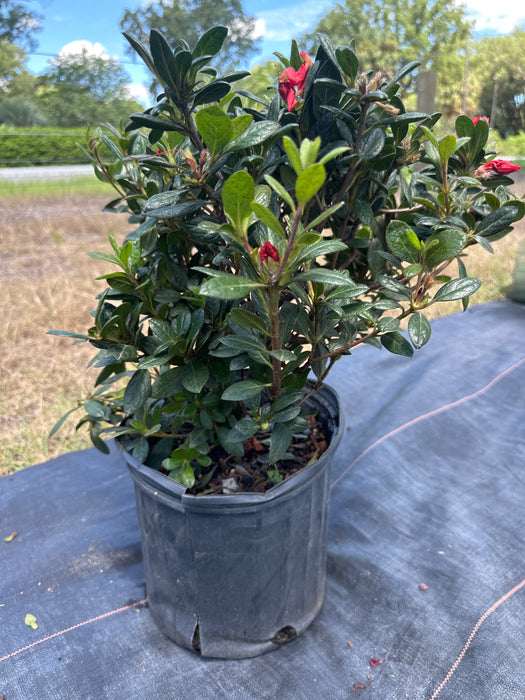


Azaleas Deja Bloom Multiple Colors
Sale
Original price
$35.00
Original price
$35.00
-
Original price
$35.00
Original price
$35.00
Current price
$10.00
$10.00
-
$10.00
Current price
$10.00
Growing Guide for Deja Bloom Azaleas
-
Best Growing Environment
- Deja Bloom Azaleas thrive in environments with well-draining, acidic soil (pH 4.5–6.0), rich in organic matter like peat moss or compost.
- They prefer partial shade or filtered sunlight, ideally with morning sun and afternoon shade to protect from intense heat, especially in warmer climates.
- These azaleas perform best in temperate climates with mild winters and moderate summers, avoiding extreme heat or cold.
-
Plant in areas with good air circulation to prevent fungal issues, and avoid low spots where water may pool.


-
Botanical Name
- The botanical name for Deja Bloom Azaleas is Rhododendron hybrid (specific cultivar: ‘RLH1-12P0’ for varieties like Confetti).
- Deja Bloom Azaleas are part of the Rhododendron genus, which includes both evergreen and deciduous azalea hybrids.
-
Common Names
- Commonly known as Deja Bloom Azaleas, these are reblooming azalea hybrids.
- Specific cultivars include names like Deja Bloom Confetti Azalea and Deja Bloom Satin Blush Azalea, often marketed for their repeat-blooming trait.
-
Average Height and Diameter
- Deja Bloom Azaleas are compact, low-growing shrubs, typically reaching an average height of 2–3 feet (0.6–0.9 meters).
-
Their diameter or spread is usually 2–4 feet (0.6–1.2 meters), making them suitable for small gardens, borders, or containers.
-
Growth Rate
- These azaleas have a moderate to slow growth rate, typically adding 4–6 inches (10–15 cm) per year under optimal conditions.
- Growth may slow in poor soil, excessive shade, or waterlogged conditions, so proper care is essential for steady development.
-
Sun Requirements
- Deja Bloom Azaleas prefer partial shade with 4–6 hours of filtered or morning sunlight daily.
- In cooler climates (e.g., USDA Zones 6–7), they can tolerate full sun if soil moisture is consistent, but in warmer zones (8–9), too much sun can scorch leaves.
-
Avoid deep shade, as it reduces blooming and weakens growth.

-
Cold Hardiness
- Deja Bloom Azaleas are cold hardy in USDA Zones 6a–9b, tolerating minimum temperatures of -10°F to 30°F (-23°C to -1°C).
- In colder zones (6a–7a), provide winter protection like burlap wrapping or heavy mulching to prevent bark splitting or leaf scorch.
-
They are less hardy than some Northern Lights hybrids but more adaptable than Southern Indian azaleas in cooler regions.
-
Water Requirements
- These azaleas require consistently moist but not waterlogged soil, especially during establishment and blooming periods.
- Water deeply 1–2 times per week, providing about 1 inch (2.5 cm) of water, depending on rainfall and soil drainage.
-
Avoid overwatering, as soggy soil can cause root rot. Mulch with pine bark or leaves to retain moisture and regulate soil temperature.
-
Detailed Fertilizing Guide
- Use a fertilizer formulated for acid-loving plants (e.g., for azaleas, camellias, or rhododendrons) with a balanced N-P-K ratio like 10-10-10 or 6-10-4.
- Apply fertilizer once in early spring after blooming and optionally again in early summer to support reblooming. Avoid fertilizing after midsummer to prevent soft growth susceptible to winter damage.
- Application method: Spread granular fertilizer evenly around the drip line (not touching the stem) and water thoroughly. For liquid fertilizers like Miracle-Gro Azalea, Camellia, and Rhododendron Plant Food, apply every 1–2 weeks during the growing season, following label instructions.
-
Avoid overfertilizing, as it can cause leaf scorch or excessive foliage at the expense of blooms. If leaves yellow (chlorosis), test soil pH and adjust if too alkaline.

-
Planting Guide
- Timing: Plant in fall (preferred) or early spring to allow roots to establish in cooler temperatures. Avoid planting in hot summer months unless ample water is provided.
- Site preparation: Choose a site with partial shade and well-draining, acidic soil. Amend soil with peat moss, compost, or pine bark to improve drainage and lower pH if needed.
- Planting process: Dig a hole twice as wide and slightly shallower than the root ball. Place the plant so the top of the root ball is 1–2 inches (2.5–5 cm) above soil level to prevent root rot. Backfill with amended soil, water thoroughly, and apply 2–3 inches (5–7.5 cm) of mulch, keeping it away from the stem.
- Aftercare: Water regularly during the first year, especially in dry periods. Prune lightly after spring bloom to shape and remove dead wood, avoiding cuts after July to protect next year’s buds.