

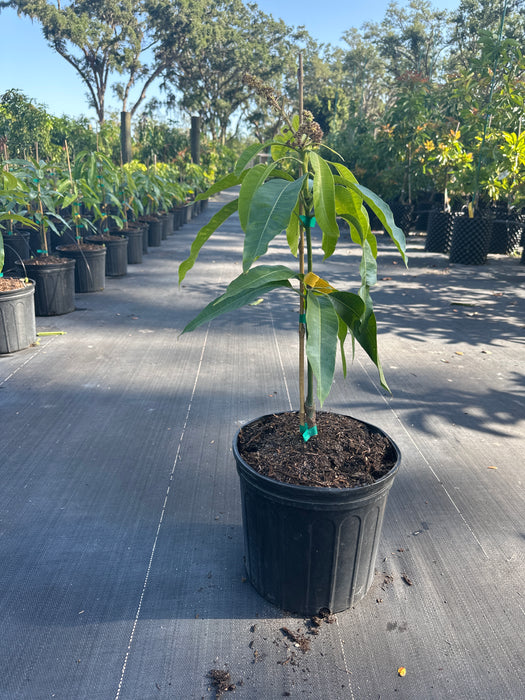

Mango-Ceci Love Tree
Original price
$59.00
-
Original price
$119.00
Original price
$119.00
$59.00
-
$119.00
Current price
$119.00
Taste:
-
The Ceci Love Mango produces medium to large fruits with a sweet, juicy flavor and a smooth, fiberless texture.
-
Its taste is often described as rich and tropical, with hints of peach and citrus, making it ideal for fresh eating, smoothies, or desserts.
-
The flesh is vibrant orange, aromatic, and melts in the mouth, offering a premium mango experience.
Best Growing Environment:
-
Thrives in tropical and subtropical climates with warm, humid conditions, ideally between 80-100F (27-38°C).
-
Prefers well-draining, sandy loam soil with a pH of 5.5-7.5, enriched with organic matter for optimal growth.
-
Benefits from a location protected from strong winds, which can damage flowers and young fruit.
Botanical Name:
-
Mangifera indica 'Ceci Love'
Common Names:
-
Ceci Love Mango
-
Love Mango
-
Ceci Mango
Average Height:
-
Typically grows to 10-15 feet (3-4.5 meters) in height when planted in the ground, making it a semi-dwarf variety.
-
In containers, it can be maintained at 4-8 feet (1.2-2.4 meters) with regular pruning.
Growth Rate:
-
Moderate growth rate, adding about 1-2 feet (0.3-0.6 meters) per year under ideal conditions.
-
Grafted trees, like the Ceci Love, begin fruiting within 2-4 years, faster than seed-grown trees.
Sun Requirements:
-
Requires full sun, with at least 8 hours of direct sunlight daily to ensure robust growth and fruit production.
-
Insufficient light can lead to reduced flowering and smaller yields.
Cold Hardiness:
-
Sensitive to cold, with damage to foliage and flowers occurring below 40F (4°C); severe damage or death below 30F (-1°C).
-
Suitable for outdoor growth in frost-free areas; in cooler climates, it should be grown in containers and brought indoors during winter.
Water Requirements:
-
Needs regular watering during establishment, keeping soil evenly moist but not soggy, about 2-3 times per week for the first 2 months.
-
Once established, water deeply once a week during dry periods, reducing frequency in fall and winter to avoid overwatering.
-
Drought-tolerant to some extent, but consistent moisture improves fruit quality.
Planting Guide:
-
Plant in spring after the last frost in a sunny, well-draining location; dig a hole 3-4 times wider and as deep as the root ball.
-
Mix native soil with compost (50:50 ratio) to improve drainage; plant at the same depth as in the nursery container, avoiding burying the trunk.
-
Water thoroughly after planting, apply a 2-3 inch (5-7 cm) layer of organic mulch around the base, keeping it away from the trunk.
-
Space trees 10-15 feet (3-4.5 meters) apart for ground planting; for containers, choose a pot at least 20 inches (50 cm) wide with drainage holes.
Fertilizing Times and Recommended Fertilizer:
-
Fertilize young trees every 2-3 months during the first year, starting in spring (March), then summer (June), and early fall (September).
-
Use a balanced, slow-release fertilizer like 6-6-6 or a tropical fruit tree blend with low nitrogen (e.g., 6-3-16) to avoid burning roots.
-
For mature trees, apply fertilizer 2-3 times per year: early spring (February), late spring (May), and late summer (August), using 1-2 pounds (0.45-0.9 kg) per inch of trunk diameter.
-
Supplement with micronutrients like iron and magnesium annually, especially in sandy soils, to prevent deficiencies.
USDA Zone:
-
Thrives in USDA Zones 9b-11 for outdoor planting.
-
In Zones 4-9a, grow in containers and move indoors or to a greenhouse when temperatures drop below 40F (4°C) to protect from frost.